
TODAY’S WORD

HIGH FIVE!

Let’s explore Psalm 92 together. This beautiful psalm is often called the “Sabbath Psalm” and is meant to be sung or recited on the Sabbath day. Here are some key points from Psalm 92:

  1. Praise and Thanksgiving: The psalm begins with a declaration of praise: “It is good to give thanks to the LORD, to sing praises to your name, O Most High” (verse 1). It encourages us to express gratitude for God’s goodness.
  2. The Righteous Flourish: Verses 12-14 highlight the flourishing of the righteous: “The righteous flourish like the palm tree and grow like a cedar in Lebanon. They are planted in the house of the LORD; they flourish in the courts of our God. They still bear fruit in old age; they are ever full of sap and green.”
  3. God’s Faithfulness: Psalm 92 emphasizes God’s faithfulness and His role as the Rock and Redeemer: “For you, O LORD, have made me glad by your work; at the works of your hands I sing for joy” (verse 4).
  4. Musical Instructions: The psalm also includes musical instructions, indicating that it was meant to be sung: “A psalm. A song for the Sabbath day.”
  5. Reflection on the Wicked: Toward the end, the psalm contrasts the fate of the wicked with that of the righteous. While the wicked may seem to prosper temporarily, their ultimate destiny is destruction (verses 6-9).
  6. Perseverance and Trust: Overall, Psalm 92 encourages perseverance, trust in God, and a heart of worship. It reminds us that even in challenging times, we can find strength and joy in our relationship with the Lord.

Feel free to explore the entire psalm, and let me know if you have any specific questions or if there’s anything else you’d like to learn! 🙏🌟

  • GYM
  • GROCERY STORE
  • SUTLIFF
  • LAUNDRY
  • READ CH 6 OF “The Formation of the Resurrection Narratives”
  • JOB ROTATION
  • ROTARY

TODAY’S WORD

HIGH FIVE!

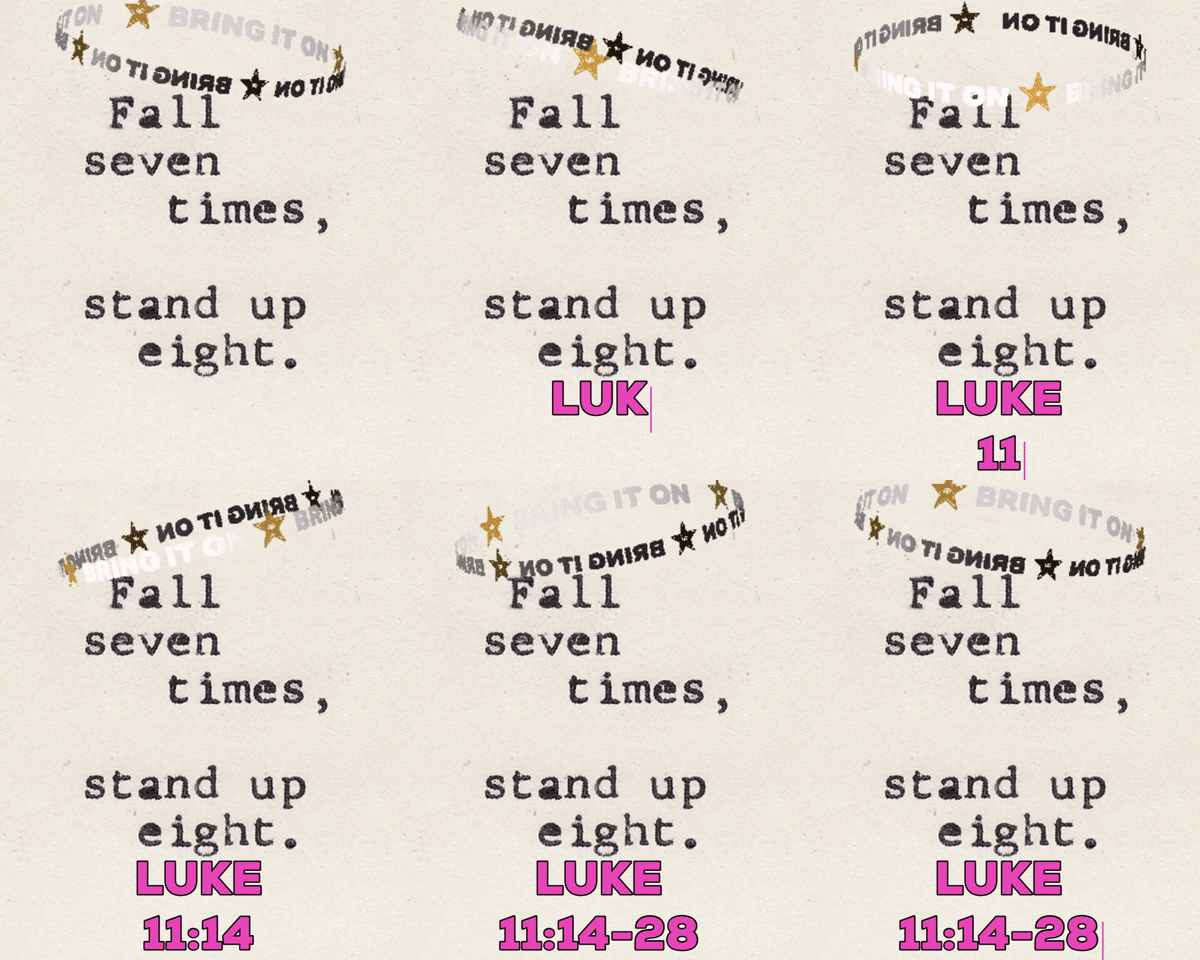
In Luke 11:14-28, Jesus was driving out a demon that had caused a man to be mute. When the demon left, the man regained his ability to speak, and the crowd was amazed. However, some people accused Jesus of casting out demons by the power of Beelzebul, the prince of demons. Jesus responded by emphasizing that a kingdom divided against itself cannot stand, and if He was indeed driving out demons by the finger of God, then the kingdom of God had come upon them. He also warned about the danger of an impure spirit returning with even more wicked companions. Finally, Jesus declared that those who hear the word of God and obey it are truly blessed. 🙏

Is there anything else you’d like to know? 😊

#BRINGITON

TODAY’S WORD

HIGH FIVE!

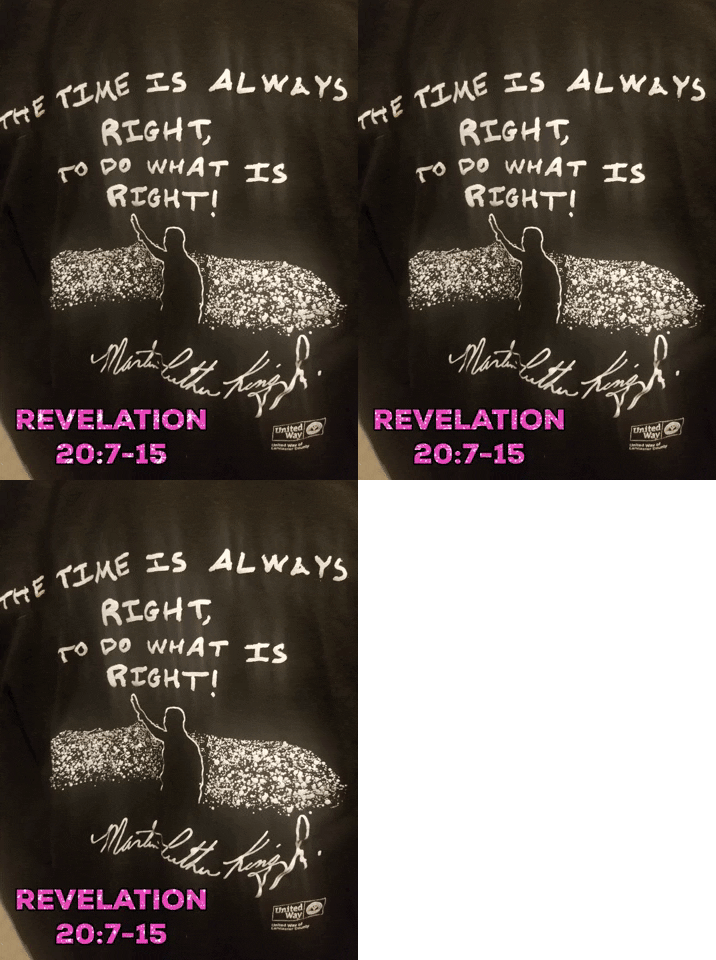
The text in the image carries significant meaning. It features a quote attributed to Martin Luther King Jr.: “THE TIME IS ALWAYS RIGHT, TO DO WHAT IS RIGHT!” Below the quote, there’s a signature that appears to be Martin Luther King Jr.’s. Additionally, the image includes the reference “REVELATION 20:7-15,” suggesting a connection between the quote and a biblical passage.

The combination of an inspirational message, a famous figure’s signature, and a biblical reference makes this image thought-provoking. It encourages ethical action and aligns with Martin Luther King Jr.’s legacy of advocating for justice and equality. 🌟

TODAY’S WORD

HIGH FIVE!

In Islam, the Book of Psalms (known as “Zabur” in Arabic) holds a special place as one of the revealed scriptures. While the entire Psalms collection is not explicitly mentioned in the Quran, certain themes and verses from Psalms resonate with Islamic teachings. Here are some points of significance:

  1. Common Prophetic Heritage: Muslims believe in the continuity of prophethood from Adam to Muhammad. As such, the Psalms are attributed to Prophet David (Dawud in Arabic), who is revered as a prophet in Islam. Muslims recognize David as a righteous king, poet, and musician.
  2. Spiritual Guidance: Although the Quran is the primary source of guidance for Muslims, they acknowledge the divine origin of the Psalms. The Zabur is considered a predecessor to the Quran, and its verses are believed to contain wisdom, supplications, and praises to God.
  3. Themes Shared with the Quran:
    • Tawhid (Monotheism): Psalms emphasize the oneness of God (Allah) and His sovereignty. Muslims find resonance in verses that exalt God’s greatness and emphasize reliance on Him.
    • Praise and Gratitude: Many Psalms express gratitude, praise, and awe toward God’s creation. Muslims also engage in similar acts of worship, including daily prayers (Salat) and supplications (Du’a).
    • Seeking Refuge: Psalms often seek refuge in God from enemies, distress, and hardship. Muslims recite similar prayers seeking God’s protection and guidance.
    • Repentance and Forgiveness: Psalms contain pleas for forgiveness and repentance. Muslims also seek God’s forgiveness and turn to Him in times of remorse.
  4. Shared Figures: The Quran mentions several prophets, including David (Dawud), Solomon (Sulaiman), and others. Their stories and virtues are shared across both scriptures.
  5. Literary and Poetic Value: Muslims appreciate the poetic beauty and eloquence of the Psalms. The Zabur’s lyrical style resonates with Arabic poetry, which holds a significant place in Islamic culture.
  6. Interfaith Dialogue: Some scholars engage in comparative studies between the Psalms and the Quran, fostering interfaith dialogue and understanding.

In summary, while the Psalms are not recited in daily Islamic rituals, their spiritual and historical significance connects Muslims to a shared Abrahamic heritage. Muslims respect the Psalms as part of divine revelation and appreciate their timeless messages of faith, hope, and devotion. 🙏✨

NO WORD TODAY (story time)

HIGH FIVE!

🍫 The Sweetness at Hershey’s Chocolate World: Create Your Own Candy Bar! 🍫


In the heart of CHOCOLATETOWN, USA—Hershey, Pennsylvania—lies a magical place where dreams are dipped in chocolate and imagination takes the form of candy bars. Welcome to Hershey’s Chocolate World, where the air smells like cocoa and the joy is as rich as a kiss. A HERSHEY’S KISS.

Meet Lily, a wide-eyed visitor who had heard whispers about the legendary Create Your Own Candy Bar Experience. She stepped through the chocolate-scented doors, her anticipation bubbling like a freshly poured fountain of molten cocoa.

The room was alive with activity. Conveyor belts hummed, and chocolatiers danced around like sugar-coated elves. Lily approached the attraction, where Ms. Kiss greeted her.

“Welcome to the sweetest adventure!” Ms. Kiss said. “Are you ready to create your very own candy bar?”

Lily nodded, her heart racing. She followed Ms. Kiss to a gleaming station. The air buzzed with excitement as she donned a hairnet and apron. The ingredients lay before her like a painter’s palette: velvety milk chocolate, crunchy pretzels, vanilla chips, semi-sweet chocolate chips, toffee bits, cookie bits, and rainbow sprinkles.

“First,” Ms. Kiss said, “choose your chocolate base. Dark, milk, or white?”

Lily hesitated. Dark chocolate was mysterious, milk chocolate comforting, and white chocolate ethereal. She decided on milk—a classic canvas for her confectionary masterpiece.

Next came the mix-ins. She implemented pretzels in her creation like a flour technician, directed cookie bit insertion, and added toffee because she could. Her candy bar was taking shape—a symphony of flavors.

Next Ms. Kiss introduced the great chocolate making machine.

As Lily pulled the lever, the conveyor belt carried her creation away. She watched, mesmerized, as it transformed from flowing chocolate to a solid bar.

“Congratulations!” Ms. Kiss beamed. “Your candy bar is born.”

“Now,” Ms. Kiss said, “design your wrapper. What colors speak to your soul?”

Lily picked shades of cocoa brown and gold, with room to insert her claim. She crafted a whimsical wrapper with her name on the front and the Hershey Chocolate World logo. This was more than a candy bar; it was her sweet story.

Lily held it, her heart swelling. She took a bite—the crunch of pretzels, the sweetness of toffee—it was pure bliss. Her taste buds danced a waltz, and she knew she’d never forget this moment.

But the adventure didn’t end there. She explored the rest of Hershey’s Chocolate World: the Great Candy Expedition (where chocolate secrets whispered), the Hershey Trolley Works (a cocoa-powered time machine), and the largest candy store (where jolly ranchers wave hello).

As she left, her personalized candy bar tucked safely in her bag, Lily vowed to return. Because Hershey’s Chocolate World wasn’t just a place; it was a portal to childhood wonder, where dreams melted into reality.

So, dear reader, if you crave magic wrapped in foil, if you yearn to be both artist and chocolatier, follow the cocoa-scented path to Hershey’s Chocolate World. Your candy bar awaits—a sweet symphony composed by you. 🌟


Visit Hershey’s Chocolate World at 101 Chocolate World Dr, Hershey, PA and let your sweet adventure begin! 🎉

TODAY’S WORD

HIGH FIVE!

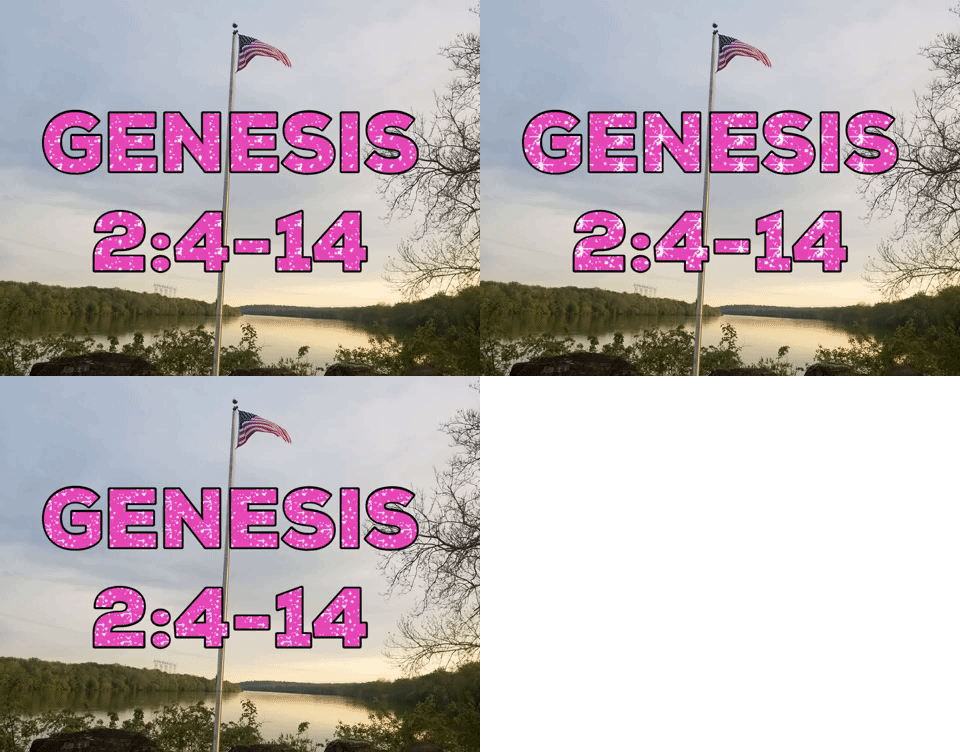
Genesis 2:4-14 provides a fascinating glimpse into the early days of creation and the Garden of Eden. Let’s explore its key points together:

  1. Creation of Man and Garden:
    • After describing the broader creation of the heavens and the earth, Genesis 2 zooms in on the specific details.
    • God formed Adam (the first man) from the dust of the ground and breathed life into him, making him a living being.
    • God planted a beautiful garden in the east, called Eden, and placed Adam there.
  2. The Garden’s Features:
    • In Eden, God made various trees grow—trees that were both pleasing to the eye and good for food.
    • Two significant trees were present:
      • The Tree of Life: Symbolizing eternal life.
      • The Tree of the Knowledge of Good and Evil: Representing moral choice and consequences.
  3. Four Rivers Flowing from Eden:
    • A river watered the garden, flowing from Eden and then dividing into four headwaters:
      1. Pishon: Winding through the land of Havilah, where gold was found.
      2. Gihon: Flowing through the land of Cush.
      3. Tigris: Running along the east side of Ashur.
      4. Euphrates: The fourth river.

These verses provide a glimpse into the pristine world before sin entered, emphasizing God’s care for humanity and the richness of the environment. If you have more questions or want further insights, feel free to ask or comment! 😊

TODAY’S WORD

HIGH FIVE!

In this passage, the apostle Paul not only discusses our earthly bodies and the hope of resurrection but also emphasizes the role of Jesus Christ in this transformative process. Let’s explore the significance of 2 Corinthians 5:1-5 together:

  1. Our Temporary Earthly Bodies:
    • Paul acknowledges that our physical bodies are like tents—temporary dwellings. They are subject to decay, suffering, and mortality.
    • However, through Jesus Christ, we have hope beyond the limitations of our current bodies.
  2. The Hope of Resurrection:
    • Jesus’ death and resurrection provide the ultimate hope for believers.
    • Just as Jesus conquered death, we look forward to receiving new, eternal bodies from God—a heavenly dwelling.
    • These resurrected bodies will not be subject to decay, pain, or death.
  3. Groaning and Longing:
    • While in our earthly bodies, we experience groaning and longing for something more.
    • Jesus’ sacrifice assures us that our groaning will be replaced with joy and fulfillment in the resurrection.
  4. The Role of the Holy Spirit:
    • Paul mentions the Holy Spirit as a guarantee—a down payment—of what is to come.
    • Through Jesus, we receive the Holy Spirit, who transforms us and prepares us for our future imperishable bodies.

In summary, Jesus Christ is central to our hope of resurrection. His victory over death assures us that our mortal bodies will be transformed into immortal ones. 🌟 If you have further questions, feel free to ask! 😊

Go back

Your message has been sent

Warning
Warning
Warning
Warning.

TODAY’S WORD

HIGH FIVE!

The text “PSALM 130” holds religious significance and is associated with the Book of Psalms in the Bible. Let me provide some context:

  1. Biblical Context:
    • Book of Psalms: The Book of Psalms, also known as Psalter, is a collection of religious songs, prayers, and poems found in the Hebrew Bible (Old Testament) and the Christian Bible.
    • Psalm 130: This specific psalm is part of the larger collection and is known as one of the “Penitential Psalms.” These psalms express themes of repentance, forgiveness, and seeking God’s mercy.
    • Content of Psalm 130: The psalmist begins by crying out to God from the depths, acknowledging their sinfulness and need for forgiveness. They express hope in God’s mercy and redemption, waiting for the Lord like a watchman waits for the morning.
  2. Themes and Significance:
    • Repentance and Forgiveness: Psalm 130 emphasizes the human condition of sin and the need for forgiveness. It reflects the longing for reconciliation with God.
    • Hope and Trust: Despite the depths of despair, the psalmist places their hope and trust in God’s steadfast love and redemption.
    • Universal Appeal: The themes in Psalm 130 resonate with people across different faith traditions, emphasizing the universal human experience of seeking forgiveness and hope.
  3. Liturgical Use:
    • Worship and Devotion: Psalm 130 is often recited or sung during religious services, especially during times of penitence, such as Lent or other solemn occasions.
    • Individual Reflection: Many individuals turn to this psalm for personal reflection, seeking comfort and assurance in times of spiritual struggle.

In summary, “PSALM 130” represents a cry for forgiveness, hope, and trust in God’s mercy—a timeless expression of the human heart seeking divine connection. 🙏✨

  • NO GYM… NO CAR… Boo.
  • READ Chapter 5 of “TFORN”
  • GROCERY STORE
  • LAUNDRY
  • ROTARY