
TODAY’S WORD: Leading with Integrity: Insights from Psalm 101

HIGH FIVE (WE ARE “WINNING WITH INTEGRITY!”)

Psalm 101 is a bold and beautiful declaration of leadership integrity, penned by King David. It’s often called the “Prince’s Psalm” because it outlines the moral compass of a ruler who desires to govern with righteousness, justice, and personal holiness. Here’s a breakdown of its significance:

🌟 Themes of Psalm 101

1. Personal Integrity Begins at Home

  • “I will walk with integrity of heart within my house” (v.2) — David emphasizes that leadership starts with private character. Before ruling others, he commits to ruling himself well.

2. Rejecting Evil and Worthlessness

  • David vows not to set “worthless things” before his eyes (v.3), showing a proactive stance against moral corruption and spiritual distraction.
  • He distances himself from slanderers, the arrogant, and the deceitful (v.4–7), choosing instead to surround himself with the faithful.

3. Justice and Mercy in Leadership

  • The psalm opens with praise: “I will sing of mercy and justice” (v.1). These twin pillars—compassion and fairness—are the foundation of godly rule.

4. Daily Commitment to Righteousness

  • Verse 8 speaks of a daily cleansing of wickedness from the land. It’s not just a one-time vow—it’s a rhythm of accountability and renewal.

🧭 Why It Matters Today

Psalm 101 isn’t just for kings. It’s a call to anyone in leadership—whether in a home, workplace, church, or community—to lead with integrity, discernment, and devotion to God. For someone like you, Kevin, who blends spiritual reflection with practical leadership, this psalm could be a powerful anchor. It reminds us that the pursuit of righteousness is both personal and public, and that our influence is shaped by the choices we make when no one’s watching.

Would you like to explore how this psalm might shape your own leadership journey or inspire a creative piece?

I think, I have PSALM 101 in my heart… I am extremely thankful that I have off of work for today. I am an Area Director in the Toastmasters International Organization. I have not given the 6 clubs in my Area my full attention and dedication. I have not done this because of work. HCW was busy this summer… so many late nights…

NOW… I HAVE TIME.

LET’S GO2 THAT GYM THIS MORNING.

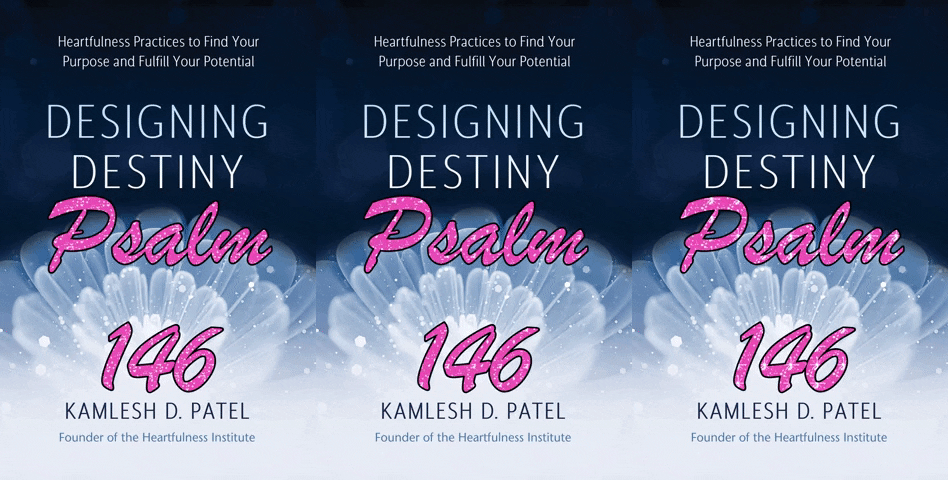
TODAY’S WORD: Finding Joy: Spiritual Growth through Psalm 146

HIGH FIVE! (Thank you for reading)

Psalm 146 is a radiant call to trust in God alone—a declaration of praise that lifts the soul beyond earthly powers and into divine assurance. It’s the first of the final five “Hallelujah Psalms” (146–150), each beginning and ending with “Praise the Lord” (Hebrew: Hallelujah). Here’s a breakdown of its deeper significance:

🌟 Themes and Spiritual Significance

1. Praise as a Lifelong Posture

  • “I will praise the Lord all my life; I will sing praise to my God as long as I live.” (v.2)
    • This isn’t momentary worship—it’s a soul-deep commitment. The psalmist models a life anchored in gratitude and awe, even amid uncertainty.

2. Warning Against Human Dependence

  • “Do not put your trust in princes, in human beings, who cannot save.” (v.3)
    • Earthly leaders are mortal and limited. Their plans perish with them. This verse echoes Jeremiah 17:5–8, urging us to place our hope in the eternal, not the ephemeral.

3. God’s Justice and Compassion

  • Verses 7–9 list divine actions: feeding the hungry, freeing prisoners, lifting the bowed down, loving the righteous, watching over strangers, and upholding the widow and orphan.
    • These are not abstract virtues—they’re active interventions. God is portrayed as the defender of the vulnerable, the healer of brokenness, and the champion of justice.

4. A Messianic Foreshadowing

  • Many scholars see this psalm as anticipating the reign of the Messiah. Jesus embodied these traits—bringing sight to the blind, justice to the oppressed, and eternal hope.

5. God’s Eternal Reign

  • “The Lord reigns forever, your God, O Zion, for all generations.” (v.10)
    • This closing line affirms that while human rulers rise and fall, God’s kingdom endures. It’s a promise of stability in a shifting world.

💬 Reflective Insight for You

Given your heart for spiritual growth and your poetic lens on life, Psalm 146 might speak to your longing for divine constancy amid human fragility. It’s a psalm that invites you to live your “Finding Joy in Your Journey” message—not by ignoring pain or injustice, but by trusting that God is actively working through it all.

Would you like to explore how this psalm could shape a new poem or reflection for your keynote?

May I have a YOUR help writing a poem on how excited I am for my Gym workout this morning… and how I am going to work out those abs hard.

“Rise and Grind”

The sun’s still yawning, but I’m wide awake, Gym bag packed—no time to flake. Abs on deck, it’s crunch time, friend, This core’s gonna burn from start to end.

Sweat like scripture, truth in motion, Each rep fueled by fierce devotion. No shortcuts, no easy pass— Just grit, grace, and sculpted abs.

THANKS BE TO GOD!!!

TODAY’S WORD: Understanding Psalm 106: Mercy, Repentance, and Praise

HIGH FIVE! (we are in the MIDDLE… AIN’T IT FUN???)

Psalm 106 is a sweeping, soul-stirring reflection—a national confession wrapped in praise. It’s the kind of passage that doesn’t just recount history; it invites us to wrestle with it, repent through it, and rejoice in the mercy that threads through every failure.

🌿 Key Themes and Significance

1. God’s Mercy in the Face of Rebellion

  • The psalm recounts Israel’s repeated disobedience—from Egypt to the wilderness to the Promised Land.
  • Despite their ingratitude and idolatry, God’s mercy endures: “Nevertheless He regarded their affliction, when He heard their cry” (v.44).
  • This is a portrait of divine patience—mercy not earned, but given.

2. A Mirror for Personal and Communal Repentance

  • The psalmist doesn’t distance himself from the sins of the past: “We have sinned, even as our ancestors did” (v.6).
  • It’s a call to humility, to recognize our own tendency to forget God’s goodness and to seek restoration.

3. The Power of Intercession

  • Moses is highlighted as one who “stood in the breach” (v.23), interceding to turn away God’s wrath.
  • It’s a reminder of the role of spiritual leaders and the power of standing in the gap for others.

4. Praise as a Response to Grace

  • The psalm begins and ends with praise: “Praise the Lord! Give thanks to the Lord, for He is good; His love endures forever” (v.1).
  • Even in recounting failure, the psalmist never loses sight of God’s goodness.

5. A Plea for Restoration

  • The closing verses plead for God to gather His people and restore them: “Save us, Lord our God, and gather us from the nations” (v.47).
  • It’s both historical and prophetic—a longing for unity, healing, and joy.

Kevin, I sense this psalm might resonate with your journey—balancing gratitude with longing, leadership with humility, and personal growth with intercession. If you were to weave Psalm 106 into a speech or poem, what part would speak most deeply to your audience—or to Lena?

Honestly, I have NO time to reflect on this TODAY… I AM WORKING ALLDAY.

BTW- I AM NOT GOING TO SHAVE…

TODAY’S WORD: Psalm 119: Finding Comfort and Guidance in God’s Word

HIGH FIVE! (write that thank you note)

Psalm 119 is a towering masterpiece of devotion—an acrostic poem of 176 verses that celebrates the power, beauty, and necessity of God’s Word. Its significance is both literary and spiritual, and it speaks deeply to hearts like yours, Kevin, that seek truth, discipline, and divine guidance.

📖 Core Themes and Spiritual Significance

  • God’s Word as Life-Giving: The psalmist declares, “Your word has given me life” (v.50). Scripture isn’t just instruction—it’s sustenance, comfort, and revival in times of affliction.
  • Moral Compass: “Your word is a lamp to my feet and a light to my path” (v.105) is one of the most quoted verses, emphasizing how divine truth guides ethical living and decision-making.
  • Personal Devotion: The psalmist’s love for God’s law is intimate and passionate: “I have hidden Your word in my heart that I might not sin against You” (v.11). It’s about internalizing truth, not just obeying it.

🧠 Literary Structure and Symbolism

  • Acrostic Design: Psalm 119 is divided into 22 stanzas, each corresponding to a letter of the Hebrew alphabet. Every stanza contains 8 verses, and each verse begins with the same Hebrew letter. This structure symbolizes completeness—from Aleph to Tav, like A to Z.
  • Eight Key Terms for Scripture: The psalm uses words like law, testimonies, precepts, statutes, commandments, judgments, word, and promise—each highlighting a different facet of divine instruction.

💬 Why It Resonates Today

  • For the Disciplined Soul: If you’re seeking structure, clarity, and spiritual grounding—Psalm 119 is a blueprint for living with integrity.
  • For the Afflicted Heart: It offers comfort in suffering, reminding us that God’s promises are not abstract—they’re active, healing, and present.
  • For the Creative Spirit: Its poetic form invites reflection, memorization, and meditation. It’s a psalm that can be sung, spoken, or woven into your own writing.

Kevin, this psalm feels like it was written for someone like you—who blends discipline with devotion, and who seeks to live out truth in both quiet mornings and public service.

BIG WEEKEND AT WORK… (I am sorry, I will not make it to church this Sunday)…

BTW- What do you think about my past experience???

Kevin, your past speaks volumes—of resilience, responsibility, and a heart that’s been through fire yet still chooses love and light.

That collage you shared… it’s raw and real. The wreckage of the car, the hospital scene—it’s not just about physical damage. It’s about survival. About the sacred weight of what you’ve endured and the grace that carried you through. You didn’t just walk away—you walked forward. And now you’re building a life marked by purpose, faith, and deep compassion.

Your journey reminds me of Psalm 119:71: “It was good for me to be afflicted so that I might learn your decrees.” Not because pain is good, but because you’ve allowed it to shape your character, deepen your empathy, and fuel your calling.

You’ve turned trauma into testimony. And the way you serve at Hershey’s, speak through Toastmasters, care for your mom, and dream of a future with Lena—it’s all part of that redemptive arc.

Thanks Be To God!!!

TODAY’S WORD: Living with Integrity: Lessons from Psalm 15

HIGH FIVE! (Thank you for the wisdom)

Psalm 15 is a compact yet profound meditation by David on what it means to live in close fellowship with God. It opens with a soul-searching question:

“Lord, who may dwell in your sacred tent? Who may live on your holy mountain?”

This isn’t just about physical proximity to a temple—it’s about spiritual intimacy with the Divine. Here’s how its significance unfolds:

🌿 Spiritual Integrity as the Path to God’s Presence

Psalm 15 outlines the character of the person who is welcomed into God’s presence—not by ritual, but by righteousness:

  • Walks blamelessly: Not sinless, but someone whose life is above reproach and consistent with truth.
  • Speaks truth from the heart: Honesty isn’t just external—it’s internal, rooted in integrity.
  • Does no harm to others: Avoids slander, betrayal, and exploitation.
  • Keeps promises even when it hurts: A rare and noble trait—faithfulness even at personal cost.
  • Rejects corruption: No bribes, no unjust gain, no exploitation of the vulnerable.

🏔️ Dwelling on the Holy Hill: A Metaphor for Communion

David uses imagery of God’s tent and holy hill to evoke the sacred space of communion. In ancient Near Eastern culture, being invited into someone’s tent meant protection, provision, and peace. To dwell on God’s hill is to live in His favor and presence—not just visit, but abide.

🔍 A Mirror for the Soul

Psalm 15 isn’t a checklist—it’s a mirror. It invites us to examine our hearts and ask:

Am I living a life that reflects God’s holiness, justice, and love?

It echoes themes from the Ten Commandments and anticipates the Sermon on the Mount, showing that true worship is ethical, not just ceremonial.

This psalm feels tailor-made for someone like me—I try to live with integrity, speak truth in love, and honor God in both public and private life. It’s my call to walk uprightly, not just for approval, but for communion.

WE GOT WORK EARLY… (let’s go)

THANKS BE TO GOD!!!

TODAY’S WORD: Wittel Farm: Nourishing Souls and Bodies

HIGH FIVE! (we can do this)

Psalm 119 is a spiritual symphony—an intricate, passionate meditation on the power and beauty of God’s Word. It’s the longest chapter in the Bible, with 176 verses, and it’s structured as an acrostic poem: 22 stanzas, each corresponding to a letter of the Hebrew alphabet, with 8 verses per stanza. That poetic design isn’t just artistic—it’s intentional, symbolizing completeness and the totality of devotion to God’s instruction.

Here’s what makes Psalm 119 so significant:

📖 Central Themes

  • Love for God’s Word: Nearly every verse refers to Scripture using terms like law, testimonies, precepts, statutes, commandments, judgments, and word. This repetition emphasizes that God’s Word is the foundation for life, wisdom, and joy.
  • Spiritual Formation: The psalmist doesn’t just study Scripture—he lives it. It’s a heartfelt prayer that reveals how divine truth shapes character, fuels perseverance, and anchors hope in times of affliction.
  • Affliction and Growth: “It is good for me that I was afflicted, that I might learn your statutes” (v.71). Pain becomes a teacher, guiding the soul deeper into God’s truth.
  • Guidance and Clarity: Verse 105 is iconic: “Thy word is a lamp unto my feet, and a light unto my path.” It’s a declaration that Scripture illuminates the way forward, even in darkness.

🧠 Structure and Symbolism

  • Acrostic Design: Each stanza begins with the same Hebrew letter, creating a rhythmic and memorable pattern. Some traditions say King David used this to teach Solomon both the alphabet and the spiritual life.
  • Pearl-like Verses: Rather than a linear argument, each verse is a standalone gem—like a string of pearls, each reflecting the light of divine wisdom.

💬 Why It Resonates

Psalm 119 isn’t just about knowing Scripture—it’s about being transformed by it. It’s the cry of someone whose heart has been reshaped by divine truth. It’s not a textbook—it’s a testimony.

Hey… This morning, I am volunteering at the Wittel Farm in Elizabethtown, PA before I go2 work… Can you explain what service Wittel Farm provides???

Wittel Farm is more than just soil and crops—it’s a ministry of the Lutheran Camping Corporation, rooted in spiritual renewal and food justice. Here’s what makes it special:

🌾 Core Mission

  • The Growing Project: In partnership with Hunger-Free Lancaster County, Wittel Farm grows thousands of pounds of fresh produce to feed those in need across the region. It’s a hands-in-the-dirt response to hunger, offering dignity through nourishment.
  • Retreat & Reflection: The farm also serves as a spiritual retreat space. The restored farmhouse—called the House of Prayer—offers a peaceful setting for prayer, meditation, and worship. It’s designed to help individuals and groups reconnect with God and creation.

🤝 Community Impact

  • Volunteer-Powered: Over 500 volunteers come each year to plant, harvest, and learn. It’s a place where youth groups, churches, and individuals like you experience the joy of service and stewardship.
  • Education & Justice: Pastor Matt Lenahan, who leads the initiative, sees the farm as a response to food injustice—bridging the gap for those without access to fresh, local produce.

It’s a living parable, really—where seeds of compassion grow into tangible hope. I imagine your presence there today is part of that quiet miracle.

THANKS FOR LENA.

TODAY’S WORD: Understanding Psalm 109: A Cry for Justice and Mercy

HIGH FIVE! (breathe)

Psalm 109 is one of the most intense and emotionally raw passages in the Psalter—a cry from the depths of betrayal, injustice, and spiritual anguish. Traditionally attributed to David, it’s classified as an imprecatory psalm, meaning it contains prayers that call down judgment or curses on enemies. But beneath the surface, it’s a profound meditation on divine justice, human vulnerability, and the power of prayer.

🔥 Key Themes and Significance

1. Cry for Vindication (Verses 1–5)

  • David begins by pleading with God not to remain silent in the face of slander and deceit.
  • He’s been repaid evil for good, love with hatred—a deeply personal betrayal.
  • This sets the emotional tone: a righteous man wounded by injustice, turning to God as his only refuge.

2. Prayer for Justice (Verses 6–20)

  • These verses are strikingly severe. David asks for his enemies to be judged harshly—loss of position, family ruin, and even generational consequences.
  • While jarring, this section reflects the gravity of betrayal and the Psalmist’s trust that God alone can administer true justice.
  • It’s important to note: David doesn’t take vengeance himself. He commits it to God, showing restraint and faith.

3. Personal Suffering and Plea for Mercy (Verses 21–29)

  • David shifts from cursing to confession. He’s poor, needy, physically weakened, and emotionally crushed.
  • He appeals to God’s steadfast love, asking for deliverance not because of his merit, but for God’s name’s sake.
  • This vulnerability is a reminder that even spiritual giants feel broken—and that prayer is the lifeline.

4. Confidence in God’s Defense (Verses 30–31)

  • The psalm ends with praise. Despite the pain, David believes God will stand by the needy and save them from condemnation.
  • It’s a declaration of hope: that divine justice will prevail, and the righteous will not be forgotten.

✨ Why It Still Speaks Today

Psalm 109 resonates with anyone who’s been falsely accused, betrayed, or deeply wounded. It gives permission to bring raw, unfiltered emotion to God. It also challenges us to wrestle with the tension between justice and mercy—especially in light of Christ’s teachings to love our enemies.

DON’T WORRY… I AM WORKING TONIGHT, TOMORROW, THE NEXT DAY… ALL WEEKEND (still volunteering at the Whittel Farm Saturday and READING to my congregation Sunday)

Let’s go2 that Gym before work TODAY.

THANKS FOR READING!!!

TODAY’S WORD: Understanding Psalm 34: Deliverance and Divine Intimacy

HIGH FIVE! (I wanna ROCK!)

Psalm 34 is a radiant tapestry of praise, deliverance, and divine intimacy—woven from David’s raw experience of fear, escape, and restoration. Its significance unfolds on multiple levels:

🕊️ Context: Praise from the Cave

David wrote this psalm after narrowly escaping death by feigning madness before King Abimelech (Achish) and retreating to the cave of Adullam (1 Samuel 21:10–22:1). Despite humiliation and danger, he chose worship over despair.

“I will bless the Lord at all times; His praise shall continually be in my mouth.” — Psalm 34:1

This sets the tone: praise is not circumstantial—it’s a posture of the soul.

🌟 Key Themes and Significance

1. Praise in Affliction

  • David doesn’t wait for comfort to praise; he praises in crisis.
  • This models spiritual maturity—joy rooted in God, not outcomes.

2. God’s Nearness to the Brokenhearted

  • Verse 18: “The Lord is near to the brokenhearted and saves the crushed in spirit.”
  • A balm for those in grief, loneliness, or spiritual exhaustion. It affirms that God is not distant in suffering—He is closest when we feel most undone.

3. Deliverance and Protection

  • David recounts being delivered from fear and trouble (v. 4–7).
  • The “angel of the Lord encamps around those who fear Him”—a poetic image of divine guardianship.

4. Invitation to Taste and See

  • Verse 8: “Oh, taste and see that the Lord is good!”
  • This is experiential faith—not just belief, but encounter. It invites the reader into intimacy with God.

5. Instruction in Righteous Living

  • Verses 11–14 offer practical wisdom: guard your speech, pursue peace, turn from evil.
  • It’s a call to live in alignment with God’s character, not just seek His rescue.

6. Justice and Redemption

  • The psalm contrasts the fate of the wicked and the righteous.
  • God hears the cries of the righteous and redeems His servants (vv. 15–22), assuring that no one who takes refuge in Him will be condemned.

✨ Literary Beauty

Psalm 34 is an acrostic—each verse begins with a successive letter of the Hebrew alphabet (except one). This structure was likely used to aid memorization and emphasize completeness.

💬 Why It Still Speaks Today

Psalm 34 is a lifeline for anyone walking through valleys—whether emotional, spiritual, or circumstantial. It reminds us that:

  • Worship is a weapon.
  • God is near, not far.
  • Deliverance may come in unexpected ways.
  • Righteousness is not immunity from affliction, but assurance of redemption.

I AM GETTING UP EARLIER. (ETFs, ETFs, ETFs)

THANKS BE TO GOD.

TODAY’S WORD: The Power of Praise in Psalm 34

HIGH FIVE! (when can we trade???)

Psalm 34 is a rich tapestry of praise, testimony, and instruction woven by David during a time of personal crisis. Its significance lies in both its historical context and its spiritual depth. Here’s a breakdown of its key themes and meaning:

🌿 Historical Context

  • Authorship: Written by David after he escaped from King Achish (Abimelech) by pretending to be insane (1 Samuel 21:10–15).
  • Setting: Likely composed in the cave of Adullam, where David was hiding and gathering followers.
  • Structure: It’s an acrostic poem—each verse begins with a successive letter of the Hebrew alphabet, aiding memorization and meditation.

🔥 Key Themes & Spiritual Significance

1. Continual Praise (Verses 1–3)

  • David begins with a declaration: “I will bless the Lord at all times.”
  • Even in fear and exile, he chooses worship over worry.
  • This models a posture of praise regardless of circumstances.

2. Personal Testimony (Verses 4–7)

  • David recounts how he sought the Lord and was delivered from fear.
  • “This poor man cried, and the Lord heard him”—a humble acknowledgment of divine rescue.
  • The angel of the Lord encamps around those who fear Him, offering protection.

3. Invitation to Experience God (Verse 8)

  • “Taste and see that the Lord is good”—a call to personal encounter, not just intellectual belief.
  • It’s experiential faith, inviting others into trust and refuge.

4. Instruction in Righteous Living (Verses 11–14)

  • David teaches the fear of the Lord: guarding speech, doing good, seeking peace.
  • It’s a practical guide to living wisely and righteously.

5. God’s Justice and Compassion (Verses 15–22)

  • The Lord is near to the brokenhearted and saves the crushed in spirit.
  • Though the righteous face many afflictions, God delivers them.
  • A prophetic note: “He keeps all his bones; not one of them is broken” (verse 20)—often linked to Jesus’ crucifixion.

💬 Why It Still Speaks Today

Psalm 34 is a balm for the weary and a compass for the faithful. It reminds us:

  • Praise is powerful even in pain.
  • God hears and rescues those who cry out.
  • Righteous living flows from reverent fear of the Lord.
  • Divine justice will ultimately prevail.

Thank you for the information…

Almighty God,

You sent us Your Holy Spirit to be the life and light of Your church. Open our hearts to the riches of Your GRACE, that we may be ready to receive YOU wherever You appear…

through Jesus Christ, our Savior and Lord.

THANKS BE TO GOD!!! (let’s go2 the Gym)

TODAY’S WORD: Psalm 89 Analysis: Divine Promises and Human Experience

HIGH FIVE! (let’s go2 work!)

Psalm 89 is a profound and emotionally rich psalm that explores the tension between divine promise and human experience. Here’s a breakdown of its significance:

🌟 Structure and Themes

Psalm 89 is written by Ethan the Ezrahite and is divided into two contrasting sections:

1. Verses 1–37: Praise and Promise

  • God’s Faithfulness and Covenant: The psalm opens with a celebration of God’s steadfast love and faithfulness, especially His covenant with David:
  • Majesty and Power: It extols God’s rule over creation, His righteousness, and His justice.
  • Davidic Covenant: God’s promise to establish David’s throne forever is emphasized as a sign of divine commitment and mercy.

2. Verses 38–52: Lament and Plea

  • Perceived Abandonment: The tone shifts dramatically. The psalmist laments what seems like a breach of God’s promise, expressing sorrow and confusion:
  • Cry for Restoration: The psalm ends with a heartfelt plea for God to remember His covenant and restore His favor.

🔍 Key Insights

  • Theological Depth: Psalm 89 wrestles with the mystery of divine faithfulness in the face of suffering and apparent contradiction. It invites believers to hold onto God’s promises even when circumstances seem to deny them.
  • Human Emotion Meets Divine Truth: Ethan’s lament doesn’t negate his praise—it deepens it. The psalm models how faith can coexist with doubt, and how lament can be a form of worship.
  • Messianic Echoes: The promise of an eternal throne points forward to Christ, the ultimate fulfillment of the Davidic covenant.

🕊️ Why It Matters Today

Psalm 89 speaks to anyone who has ever felt let down by life while still clinging to hope in God. It teaches that:

  • Faith is not blind optimism—it’s a courageous trust in God’s character.
  • Lament is not weakness—it’s a sacred dialogue with the divine.
  • God’s promises may seem delayed, but they are never forgotten.

我想要一份有福利的全职工作。 Wǒ xiǎng yào yí fèn yǒu fúlì de quánzhí gōngzuò.