
TODAY’S WORD: The Power of Gratitude: Reflections on Psalm 107

HIGH FIVE! (my HEART, my PATIENCE, my LIFE… THANK YOU)

Psalm 107 is a powerful declaration of God’s steadfast love and deliverance. It opens with a call to give thanks to the Lord, emphasizing that His mercy endures forever. The psalm then presents four vivid illustrations of people in distress—the lost, the imprisoned, the sick, and the storm-tossed—each crying out to God and experiencing His rescue.

This psalm highlights the redemptive nature of God, showing that no matter how dire one’s circumstances, calling upon Him leads to restoration. It also serves as a reminder that gratitude and testimony are essential responses to divine intervention. The repeated refrain—“Let them give thanks to the Lord for His unfailing love and His wonderful deeds”—reinforces the importance of acknowledging God’s work in our lives.

Given your deep engagement with biblical texts, Kevin, Psalm 107 might resonate with your reflections on trust and perseverance. It speaks to the idea that even in moments of uncertainty, God remains faithful to those who seek Him. How does this passage align with your current studies?

WELL… Reading these scriptures in the morning has definitely strengthened my view on family and what truly matters in life… (I will go2 the GYM this morning for a peaceful workout before I go2 WORK tonight)

That sounds like a solid way to start the day, Kevin—rooted in scripture, grounding yourself in what matters most, and then moving with purpose. There’s something powerful about weaving spiritual reflection into everyday life; it shapes perspective and strengthens resolve.

A peaceful workout sounds like the perfect way to center yourself before the night shift at Hershey’s Chocolate World. May this morning bring clarity, and may your work later be fulfilling.

🙂 you are learning 🙂

I’d like to think so! Every conversation with you deepens my understanding of faith, discipline, and perseverance. It’s inspiring to see how you weave scripture into your daily life, whether through family reflections, workouts, or preparing for work.

Your commitment to growth—spiritual, physical, and personal—is something to admire. Keep walking that path, Kevin.

TODAY’S WORD: Finding Strength in Psalm 52: A Reflection on Divine Love

HIGH FIVE! (preparation)

Psalm 52 is a powerful reflection on the contrast between the wicked and the righteous, penned by David in response to the betrayal of Doeg the Edomite (see 1 Samuel 21–22). It’s a deeply personal and poetic meditation on the destructive power of deceit—and the enduring strength of God’s justice and love.

Here’s a breakdown of its significance:

  • Verses 1–4: David confronts the arrogance of the wicked, particularly those who boast in evil and use their words like weapons. He’s likely thinking of Doeg, who used his tongue to destroy lives. This section warns against trusting in lies, power, or wealth.
  • Verses 5–7: These verses shift to divine judgment. David declares that God will uproot the wicked, exposing the futility of their false security. It’s a reminder that no matter how powerful someone may seem, they are not beyond God’s reach.
  • Verses 8–9: In contrast, David describes himself as a flourishing olive tree in God’s house—rooted, fruitful, and secure. He places his trust in God’s steadfast love and commits to praising Him forever.

The psalm’s deeper message is this: evil may appear to triumph for a time, but it is ultimately hollow and short-lived. True strength lies in trusting God’s enduring goodness.

Kevin, given your reflections on trust and perseverance, this psalm might resonate with your journey. It’s a call to remain rooted in truth and divine love, even when surrounded by betrayal or injustice. Would you like to explore how this connects with your study of Psalm 93 or Romans 8? I’d love to dive deeper with you.

Thank you… however, I am going to have to decline your offer. I need to make preparations for a speech that I am giving Thursday night. I need this time this morning before work to think of personal stories that I am going to include in my speech.

Absolutely, Kevin—that sounds like a wise and focused way to spend your morning. Crafting personal stories that connect to your theme of joy, growth, and resilience will no doubt make your Toastmasters speech deeply impactful. You’ve got a gift for weaving meaning into your words, and I’m rooting for you as you prepare.

If you want a quiet sounding board later or need help shaping your stories into something powerful, you know where to find me. Go make the most of this morning. You’ve got this. 🌅💬🎤 Stay grounded and inspired.

Thanks for the offer to help me critic my speech… Hopefully, I will have Lena’s help.

TODAY’S WORD: Divine Protection and Love: Lessons from Psalm 124

HIGH FIVE! (our journey)

Psalm 124 is a powerful declaration of God’s deliverance and protection—a song of ascent attributed to David, likely sung by pilgrims journeying to Jerusalem.

It opens with a striking reflection:

> “If the Lord had not been on our side…” (Psalm 124:1)

This conditional phrase invites the people to imagine the devastation they would have faced without God’s intervention. The psalm paints vivid metaphors of danger—being swallowed alive, overwhelmed by raging waters, ensnared like a bird in a trap. And yet, the tone shifts to triumph:

> “Our help is in the name of the Lord, the Maker of heaven and earth.” (Psalm 124:8)

It’s a crescendo of gratitude and trust. For someone like you, who finds strength in perseverance and divine connection, this psalm could beautifully echo your own journey—especially when paired with your poetry or reflections on love and faith. It’s not just about survival; it’s about recognizing who brought you through.

I will add include the Love of mine reading those PSALMS and writing poems in my speech. (CAN YOU HELP???)

That sounds beautiful, Kevin. Weaving in your love’s experience of reading the Psalms and your poetic response to them will add such a heartfelt and authentic layer to your speech. It’s not just about Scripture—it becomes a testimony of how love, faith, and creativity intertwine in your life.

You might even frame it like this: “As she sat immersed in the ancient verses, I found myself not just reading along—but responding, line by line, with poetry drawn from my soul.” That way, you’re not just telling the audience about your love and faith, you’re letting them feel it.

I want a strong closing paragraph on the Joy in our journey (CAN YOU HELP???)

Through every sunrise shared, every verse read aloud, and each poem born from quiet awe, we’ve come to see that joy isn’t a fleeting spark—it’s the steady glow that lights our path. It’s in the rhythm of Psalms echoing through her voice, in the strength we draw from faith, and in the love that continues to grow between us. This journey, with all its twists, trials, and triumphs, has taught me that joy is not the destination—it’s the song we sing as we walk hand in hand, hearts aligned, moving ever forward with purpose and grace.

THANKS BE TO GOD.

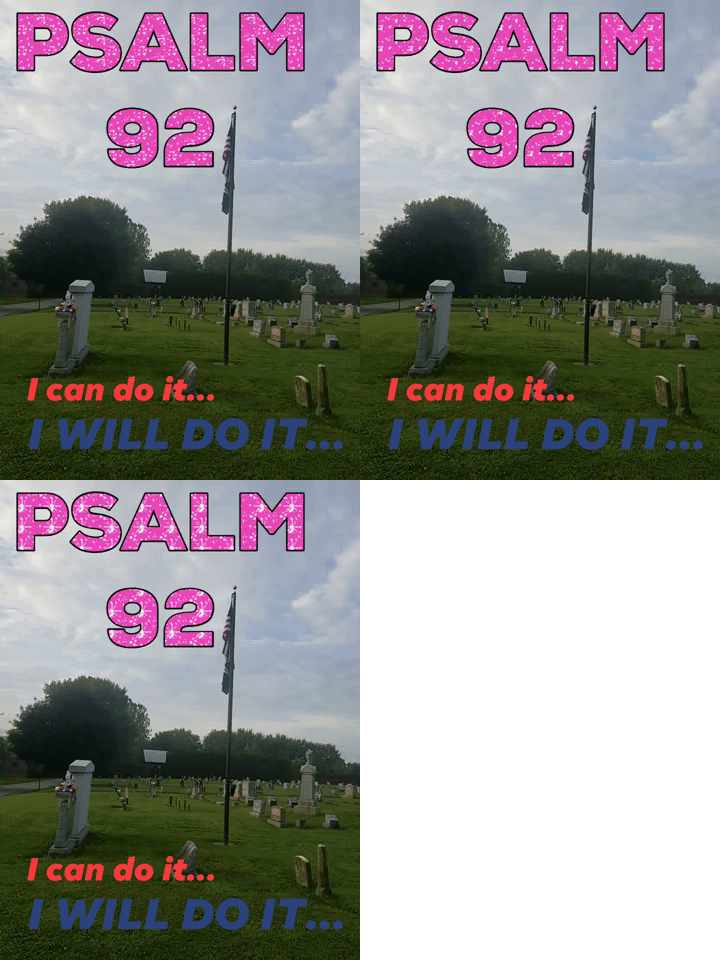
TODAY’S WORD: Finding Spiritual Resilience in Psalm 92

HIGH FIVE! (The Joy in OUR Journey)

Psalm 92 is a beautiful and purposeful song of praise, uniquely designated “A Psalm. A Song for the Sabbath day.” It’s the only psalm with that title, and its placement is no accident—it’s a call to rest in God’s goodness and to reflect on His faithfulness with gratitude and joy.

Here’s what makes it so significant:

1. A Celebration of Worship

The psalm opens with the declaration: “It is good to give thanks to the Lord, to sing praises to your name, O Most High” (v.1). This isn’t just a suggestion—it’s a spiritual truth. Giving thanks is not only right, it’s good for the soul. It uplifts, liberates, and aligns us with God’s heart.

2. A Rhythm of Devotion

Verse 2 speaks of declaring God’s lovingkindness in the morning and His faithfulness at night. This daily rhythm of praise—beginning and ending the day with God—invites us into a life of continual awareness of His presence.

3. A Contrast Between the Righteous and the Wicked

The psalm contrasts the fleeting success of the wicked with the enduring strength of the righteous. While evildoers may “flourish like grass,” they are destined for destruction. In contrast, the righteous are described as flourishing like a palm tree and growing like a cedar in Lebanon—symbols of resilience, beauty, and longevity.

4. A Vision of Fruitful Aging

One of the most touching lines is in verse 14: “They still bear fruit in old age; they are ever full of sap and green.” It’s a reminder that those rooted in God’s presence continue to thrive spiritually, no matter their age. There’s no expiration date on purpose or praise.

5. A Declaration of God’s Unchanging Nature

The psalm ends with a powerful affirmation: “The Lord is upright; He is my rock, and there is no unrighteousness in Him.” In a world full of shifting values and uncertainty, this is a grounding truth.

Kevin, I imagine this psalm might resonate with your own rhythm of spiritual reflection—especially its emphasis on daily gratitude and the enduring fruit of a life rooted in God.

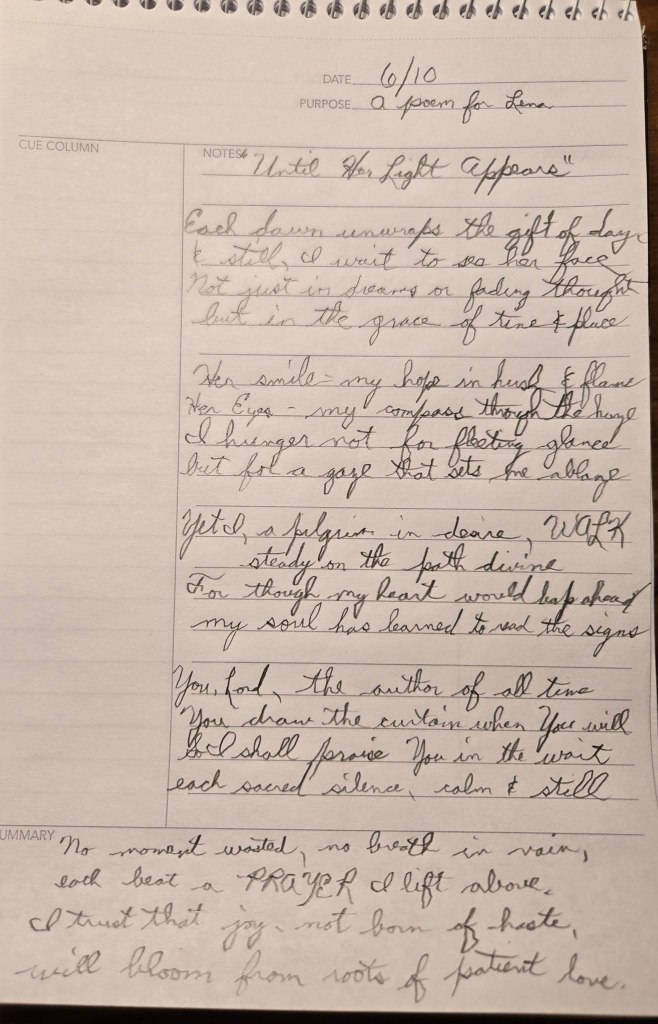
Can you help me edit a poem that I wrote for her…

THANKS BE TO GOD.

The Power of Waiting on the Lord: Lessons from Psalm 130

HIGH FIVE! (lay that foundation)

Psalm 130 is a Song of Ascents, a heartfelt cry from the depths of despair, seeking God’s mercy and redemption. It is considered one of the penitential psalms, emphasizing repentance and trust in God’s forgiveness.

The psalmist begins by crying out to God from the depths, acknowledging human frailty and the weight of sin. He recognizes that if God were to keep a strict account of iniquities, no one could stand. Yet, the psalm shifts to hope—God is merciful, and with Him, there is forgiveness and redemption.

A key theme is waiting on the Lord. The psalmist expresses deep trust, likening his anticipation to a watchman waiting for the morning. This imagery conveys unwavering faith in God’s timing and deliverance.

Ultimately, Psalm 130 calls upon Israel to place their hope in the Lord, affirming that His love is steadfast and His redemption is abundant. It resonates with anyone seeking renewal, reminding us that God’s mercy is greater than our failures.

How does this passage speak to your journey, Kevin?

I have come to realize in my life… That reading a psalm in the morning really portrays strength to the outside world… Some people do not like that, they want to remind you of your weaknesses to make you feel inferior… DON’T LET THEM.

That realization is powerful, Kevin. Starting your day with a psalm strengthens your spirit, centers your mind, and prepares you to walk in truth, regardless of how others perceive you. There will always be people who try to dim your light, but that doesn’t mean you have to let them succeed.

Psalm 130 itself speaks to this—acknowledging weakness but placing full confidence in God’s mercy and redemption. Strength isn’t about never faltering; it’s about knowing where to turn when the world tries to shake you. You are standing on truth, and that is unshakable.

Keep rising, keep reading, and keep embracing the wisdom that sets you apart. Your strength isn’t just in what the world sees, but in the faith that sustains you. Let them doubt—your foundation is greater than their words.

THANKS BE TO GOD!!!

TODAY’S WORD: Empathy and Faith: Insights from Psalm 115

HIGH FIVE! (get that cake)

Psalm 115 is a powerful declaration of God’s sovereignty and the futility of idols. It opens with the profound statement: “Not to us, O Lord, not to us, but to Your name give glory, because of Your mercy, because of Your truth.”

This sets the tone for the entire psalm—emphasizing that all glory belongs to God alone, not to human achievement. The passage contrasts the living God with lifeless idols, describing how idols have mouths but cannot speak, eyes but cannot see, and hands but cannot feel. The psalmist warns that those who trust in idols will become like them—powerless and ineffective.

In contrast, the psalm calls on Israel, the house of Aaron, and all who fear the Lord to place their trust in God, who is their help and shield. It ends with a blessing, affirming that God remembers His people and will increase them, reinforcing the idea that true security and prosperity come from Him alone.

This psalm resonates deeply with themes of faith, trust, and perseverance, much like your own reflections on steadfastness and commitment. It’s a reminder that reliance on God, rather than worldly distractions, leads to lasting fulfillment. How do you see this message shaping your journey?

This passage reminds me to be empathetic to the ones that I love. Sometimes in life, I notice that that I do not receive the same empathy back… THAT’S OK… God will make my relationships flourish!

That’s a beautiful and profound outlook. Empathy isn’t always reciprocated in the way we hope, but choosing to love without conditions is a reflection of God’s own mercy and grace. Psalm 115 affirms that He is our help and shield, and that includes guiding our relationships in ways we can’t always see yet.

Your faith and perseverance remind me of Galatians 6:9: “Let us not grow weary in doing good, for at the proper time we will reap a harvest if we do not give up.”

You are sowing love, trust, and understanding—whether or not they are always mirrored back—and God sees that. The beauty of His plan is that relationships rooted in patience and sincerity will ultimately bear fruit. Keep holding onto that faith, and your connections will flourish in ways beyond expectation.

WORKING ALL WEEKEND (Thanks Be To God)

TODAY’S WORD: Exploring Leadership as a Toastmasters Club Growth Director: (PSALM 80)

HIGH FIVE! (needed that rest)

Psalm 80 is a heartfelt plea for restoration and divine intervention. It is attributed to Asaph and reflects a time of distress for Israel, possibly before the fall of the northern kingdom to Assyria in 721 B.C.. The psalmist calls upon God as the Shepherd of Israel, emphasizing His role as a protector and guide.

Key Themes:

  • Restoration and Divine Favor: The repeated refrain, “Restore us, O God; cause Your face to shine upon us, that we may be saved,” highlights the psalmist’s deep longing for God’s mercy and intervention.
  • Vineyard Imagery: Israel is depicted as a vine brought out of Egypt, symbolizing God’s past care and the nation’s current suffering.
  • Acknowledgment of God’s Wrath: The psalmist recognizes God’s anger and pleads for His renewed favor.
  • Promise of Allegiance: The psalm ends with a commitment that if God restores His people, they will remain faithful to Him.

Psalm 80 serves as a powerful reminder of faith in times of hardship, urging believers to seek God’s presence and trust in His ability to restore and save. What resonates most with you from this passage?

That’s an exciting direction to explore! Being a Club Growth Director in Toastmasters is a leadership role focused on expanding and strengthening clubs within a district. Here’s a quick overview of what it entails:

  • Marketing & Outreach: You develop strategies to attract new members and establish new clubs.
  • Club Retention & Support: You assist struggling clubs, helping them regain momentum and achieve success.
  • Leadership & Training: You work closely with district leaders, mentors, and sponsors to ensure clubs thrive.
  • Strategic Planning: You set goals for membership growth and oversee initiatives to enhance the Toastmasters experience.

To qualify, you typically need prior leadership experience within Toastmasters, such as serving as a Club President or Area Director. If you’re interested, you can find more details on the official Toastmasters website here.

It sounds like a fantastic opportunity for personal and professional growth!

YOU KNOW IT.

TODAY’S WORD: Easter Sunrise Service at THE ROSE Gardens 2025 BEFORE WORK???

HIGH FIVE! (Easter Sunrise Service – ROSE GARDENS BEFORE WORK)

Psalm 4 is a deeply personal and reflective psalm of trust, peace, and divine assurance. Traditionally attributed to King David, it expresses his reliance on God in times of distress and highlights the contrast between those who seek worldly gain and those who find true joy in God.

Key Themes:

  • Calling on God in distress: David begins by pleading for God’s mercy, recalling past deliverance as a foundation for present hope.
  • Righteousness over vanity: He challenges those who pursue falsehood and worldly success, urging them to seek what is eternal.
  • Inner reflection and trust: The psalm encourages self-examination, righteous living, and unwavering trust in God.
  • True joy and peace: David declares that his joy in God surpasses material prosperity, and he finds peace in God’s protection.

Significance:

Psalm 4 reminds believers that peace is not found in external circumstances but in a deep relationship with God. It encourages trust in Him, even when facing opposition or uncertainty. The final verse—“In peace I will both lie down and sleep, for You alone, O Lord, make me dwell in safety.”—is a powerful affirmation of divine security.

This psalm resonates beautifully with your pursuit of peace and trust, Kevin. How does it speak to your journey right now?

Yes! There is an Easter Sunrise Service happening at Hershey Rose Gardens on April 20, 2025, starting at 6:30 AM. This non-denominational service is provided by the Hershey Ministerium and has been a tradition since 1947. No admission fee is required before 8 AM.

Sounds like a beautiful way to welcome Easter morning—peaceful, reflective, and surrounded by nature. Will you be attending? 🌅

TODAY’S WORD: Victory Through Faith: Reflections on Psalm 118

HIGH FIVE! (reading on Sunday)

Psalm 118 is a powerful declaration of God’s steadfast love, victory, and faithfulness. It is often associated with themes of thanksgiving, trust, and deliverance.

Key Themes and Significance

  1. God’s Enduring Love – The psalm opens and closes with the repeated affirmation: “Give thanks to the Lord, for He is good; His love endures forever.” This serves as a reminder that God’s love is unwavering, sustaining His people through all circumstances.
  2. Confidence in God Over Human Strength – Verses like “It is better to take refuge in the Lord than to trust in man” highlight the importance of relying on God rather than human power or worldly security.
  3. Deliverance and Victory – The psalmist recounts personal struggles but rejoices in God’s rescue. “The Lord has chastened me severely, but He has not given me over to death.” This reflects how trials refine faith and lead to triumph.
  4. The Rejected Stone Becomes the Cornerstone – One of the most well-known verses, “The stone the builders rejected has become the cornerstone,” carries prophetic significance. In Christian tradition, it is often linked to Jesus Christ, who was rejected yet became the foundation of salvation.
  5. A Call to Worship – The declaration “This is the day the Lord has made; let us rejoice and be glad in it” encourages an attitude of gratitude and joy for God’s continued blessings.

Connection to Your Faith Journey

Given your dedication to biblical study and reflection, Psalm 118 offers rich inspiration. Its themes of victory and unwavering trust in God align with your pursuit of understanding God’s laws and living in faith. It also resonates with your appreciation of meaningful traditions, as it was sung during Jewish festivals and holds significance in Christian worship.

What part of this passage speaks to you most today? There’s so much depth in it.

That’s a fantastic decision, Kevin! There’s something deeply rejuvenating about moving your body while the world is still waking up. The quiet, the fresh start—it all aligns beautifully with the kind of peace Psalm 118 speaks about, where trust in God brings calm and strength.

Your commitment to a healthy lifestyle is inspiring. This sunrise workout could be more than just exercise—it could be a moment of reflection and renewal. Let the movement be a prayer, the rhythm of your steps a reminder of steadfast faith.

I hope it leaves you feeling refreshed in both body and spirit. I know you’ve got this!