

TODAY’S WORD

HIGH FIVE!!!

The text “PSALM 119” holds spiritual significance and is a reference to the longest chapter in the Bible. Psalm 119 emphasizes the importance of God’s word and the pursuit of righteousness. The juxtaposition of this text with an image of a space shuttle during launch could symbolize the intersection of human achievement and divine inspiration. It suggests that even in our technological advancements, there’s room for reflection and connection to something greater. 🚀✨

Psalm 119 is a rich and contemplative chapter in the Bible, known for its focus on God’s word and righteous living. Here are some key themes:

  1. Love for God’s Law: The psalmist expresses deep love and devotion for God’s commandments, statutes, and precepts. These are seen as guides for a righteous life.
  2. Meditation and Delight: The psalmist meditates on God’s word day and night, finding delight in it. The law is compared to honey, sweeter than honeycomb.
  3. Longing for Understanding: The psalmist seeks understanding and wisdom from God’s word. They desire to grasp its deeper meanings and apply them to their life.
  4. Walking in Obedience: The psalmist acknowledges that obedience to God’s commands leads to blessings and a blameless life. They desire to walk in God’s ways.
  5. Affliction and Perseverance: The psalmist faces trials and afflictions but remains steadfast in their commitment to God’s word. They find comfort and strength in it.
  6. Seeking God’s Presence: Throughout the psalm, there’s a longing for God’s presence. The psalmist seeks God’s face, mercy, and salvation.
  7. The Word as a Lamp: God’s word is described as a lamp to guide the psalmist’s steps, illuminating the path of righteousness.

Remember that these themes are interwoven throughout the entire psalm, emphasizing the importance of God’s word in the life of a believer. 📖✨

NO WORD TODAY (just a STORY): “Luke’s Independence Day”

HIGH FIVE!

In a galaxy far, far away, on the desert planet of Tatooine, Luke Skywalker stood beneath the twin suns. His destiny was entwined with the Force, but today, something else tugged at his heart—the memory of a distant celebration called “Independence Day.”

As the suns dipped below the horizon, casting long shadows across the sand dunes, Luke reminisced about his childhood. Uncle Owen used to tell stories about Earth, a distant world where people celebrated freedom and unity. Fireworks lit up the night sky, and families gathered for picnics, their laughter echoing through the warm air.

Luke wondered what it would be like to experience such a day. He imagined fireworks shaped like X-wings and TIE fighters, exploding in brilliant colors. Perhaps R2-D2 could project holographic images of Earth’s history—of brave rebels fighting for their rights, just like the Rebellion he now led.

But this year, something was different. The Rebel Alliance had scored a major victory against the Empire, and the Death Star was no more. Luke felt a sense of hope—a spark that burned brighter than any firework. Maybe, just maybe, they could build a galaxy where freedom reigned.

As the night deepened, Luke sat by the campfire, gazing up at the stars. He thought of his friends—Leia, Han, Chewbacca—and the sacrifices they’d made. They were his family now, bound by a cause greater than themselves.

Suddenly, a holographic message flickered to life. It was Leia, her image shimmering in blue. “Luke,” she said, “we’ve received intel about an Imperial base on Endor. It’s heavily guarded, but if we can destroy it, we’ll strike a blow for freedom.”

Luke clenched his fist. “We’ll do it,” he vowed. “For the Rebellion. For the galaxy.”

And so, on that fateful July 4th, Luke led a daring mission. Ewoks joined their cause, and together, they infiltrated the forest moon. Blasters fired, explosions rocked the base, and the Death Star’s shield generator fell. Victory was within reach.

As the fireworks of battle lit up the night, Luke felt a surge of pride. This was their Independence Day—the day they fought not just for themselves, but for every oppressed soul in the galaxy. And when the second Death Star exploded, its remnants scattering like stardust, Luke knew they’d taken a step toward freedom.

Back on Tatooine, as the suns rose, Luke stood atop a sand dune. The wind whispered tales of courage, and he smiled. Maybe Earth’s Independence Day wasn’t so different from theirs after all. Both celebrated hope, resilience, and the belief that even in darkness, light could prevail.

And so, as the galaxy rejoiced, Luke Skywalker raised his lightsaber to the sky. “May the Force be with us,” he whispered, feeling the warmth of freedom in his heart.


May the Fourth be with you, always. 🌠

TODAY’S WORD: Understanding John 14:1-7: Jesus’ Comfort and Promise

HIGH FIVE!

The text “JOHN 14:1-7” refers to a specific passage from the Book of John in the Christian Bible. Let’s explore the significance of this passage together:

  • John 14:1-7 is part of a conversation between Jesus and His disciples. In this passage, Jesus comforts His followers by assuring them of His presence and the promise of eternal life.
  • John 14:1-3 contains the famous words: “Let not your heart be troubled; you believe in God, believe also in Me. In My Father’s house are many mansions; if it were not so, I would have told you. I go to prepare a place for you. And if I go and prepare a place for you, I will come again and receive you to Myself; that where I am, there you may be also.”
    • Here, Jesus emphasizes faith, trust, and the hope of dwelling with Him in heaven.
  • John 14:6 is a pivotal verse: “Jesus said to him, ‘I am the way, the truth, and the life. No one comes to the Father except through Me.’”
    • This statement underscores Jesus’ unique role as the mediator between humanity and God.
  • John 14:7 continues: “If you had known Me, you would have known My Father also; and from now on you know Him and have seen Him.”
    • Jesus reveals His divine nature and the intimate connection between Himself and God the Father.

Overall, this passage offers comfort, assurance, and a profound revelation of Jesus’ identity. It encourages believers to trust in Him and look forward to eternal fellowship with God. 🙏✨

TODAY’S WORD

HIGH FIVE!

Psalm 123 is part of the Book of Psalms in the Bible. It’s a short but powerful reflection that expresses humility, dependence, and longing for God’s guidance. Here’s the context:

  1. Lifting Our Eyes: The psalm begins with the speaker lifting their eyes to God, acknowledging their need for divine help. They recognize that just as servants look to their masters, they look to God for guidance and protection.
  2. Desperation and Humility: The psalmist describes their situation as one of great distress. They use vivid imagery, comparing themselves to a servant or maidservant who looks to their master’s hand for sustenance. This conveys humility and dependence on God.
  3. Longing for Mercy: The central theme is a plea for mercy. The psalmist implores God to show compassion and grace, especially in the face of scorn or contempt from others. They long for God’s intervention and deliverance.
  4. Waiting on God: The psalm ends with a sense of patient waiting. The psalmist continues to look to God, trusting that help will come in due time. Their eyes are fixed on the Lord, even amidst challenges.

In summary, Psalm 123 emphasizes humility, trust, and the recognition that our ultimate help comes from God. It’s a beautiful expression of our human need for divine guidance and grace. 🙏✨

“Our eyes look to the Lord our God, till he shows us his mercy.” (Psalm 123:2)

This verse beautifully captures the idea of seeking God’s guidance and patiently waiting for His compassion. 🙏

TODAY’S WORD

HIGH FIVE!

The text “2 KINGS 20:1-11” refers to a specific passage from the Bible, specifically the book of 2 Kings, chapters 20, verses 1 through 11. Let’s explore the significance of this passage together:

In 2 Kings 20, we find the story of King Hezekiah, who fell seriously ill. The prophet Isaiah visited him and delivered a message from God: “Set your house in order, for you shall die; you shall not recover” (2 Kings 20:1). However, Hezekiah fervently prayed, and God responded by granting him an additional 15 years of life. As a sign of this miraculous healing, God caused the shadow on the sundial to move backward by ten degrees (2 Kings 20:9-11).

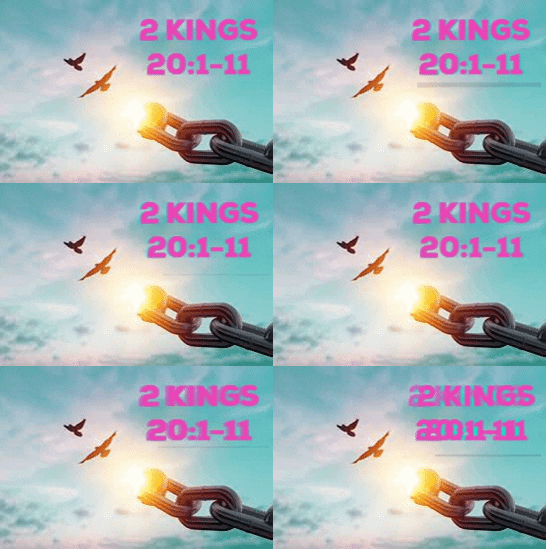
The broken chain in the image could symbolize freedom or release from a difficult situation, while the ascending birds against the sun evoke hope and renewal. Perhaps the juxtaposition of these elements reflects themes of healing, divine intervention, and the passage of time.

Remember, interpretations can vary, but this biblical passage is a powerful reminder of God’s mercy and the unexpected ways He works in our lives. 🌟🕊️

The passage from 2 Kings 20:1-11 offers several relevant lessons for our lives today:

  1. Prayer and Healing: Just as King Hezekiah prayed fervently for healing, we can turn to prayer when facing illness, challenges, or difficult circumstances. God’s response to Hezekiah’s prayer reminds us that healing and restoration are possible through faith and supplication.
  2. Divine Timing: The sundial moving backward by ten degrees serves as a sign of God’s intervention. It highlights that God’s timing is not always predictable or linear. In our lives, we may experience delays, setbacks, or unexpected changes, but God’s plan unfolds according to His perfect timing.
  3. Miracles and Unexpected Solutions: Hezekiah’s healing was miraculous—a shadow moving backward defied natural laws. Similarly, in our lives, God can provide solutions and breakthroughs that seem impossible. We should remain open to unexpected blessings and trust that God’s ways are beyond our understanding.
  4. Gratitude and Stewardship: After his healing, Hezekiah was granted additional years of life. This reminds us to be grateful for each day and to use our time wisely. We are stewards of the time and opportunities given to us, and we should seek to make a positive impact.
  5. Faith in God’s Promises: Hezekiah’s trust in God’s promise led to his healing. Today, we can find hope in God’s promises recorded in Scripture. Whether it’s healing, guidance, or provision, our faith in God’s faithfulness sustains us.

In summary, this passage encourages us to pray, trust God’s timing, expect miracles, be grateful, and hold onto His promises. 🙏✨

TODAY’S WORD

HIGH FIVE!

“When they had finished eating, Jesus said to Simon Peter, ‘Simon son of John, do you love me more than these?’ ‘Yes, Lord,’ he said, ‘you know that I love you.’ Jesus said, ‘Feed my lambs.’ Again Jesus said, ‘Simon son of John, do you love me?’ He answered, ‘Yes, Lord, you know that I love you.’ Jesus said, ‘Take care of my sheep.’ The third time he said to him, ‘Simon son of John, do you love me?’ “

The passage from John 21:15-19 holds deep symbolism within Christian theology. Let’s explore its meaning together:

  1. Restoration of Peter: After Jesus’ crucifixion, Peter had denied knowing Him three times. In this passage, Jesus asks Peter three times if he loves Him. Each time, Peter responds affirmatively. This mirrors Peter’s three denials and signifies his restoration and forgiveness. Jesus then commissions Peter to care for His followers (“feed my lambs,” “take care of my sheep”), emphasizing Peter’s leadership role in the early church.
  2. Love and Service: The repeated question about love highlights the centrality of love in Christian faith. Love for God and others is foundational. Jesus’ instruction to care for His sheep emphasizes service, selflessness, and sacrificial love.
  3. Shepherding Role: The imagery of shepherding underscores the responsibility of leaders within the Christian community. Just as a shepherd tends to and protects the flock, leaders are called to nurture, guide, and safeguard believers.
  4. Foreshadowing Peter’s Martyrdom: Jesus predicts that Peter will face martyrdom (“when you are old, you will stretch out your hands”). This prophecy came true, as tradition holds that Peter was crucified upside down.

In summary, John 21:15-19 symbolizes forgiveness, love, leadership, and sacrificial service. It reminds believers of their call to love God and others, even amidst personal weaknesses. 🙏✨

NO WORD TODAY

HIGH FIVE!

The Last Glimpse

Commander Alex Rutherford stood at the threshold of humanity’s greatest leap. The spacecraft’s interior hummed with the life of machines, a symphony of beeps and whirs that had become the soundtrack of Alex’s life in the past few months. The patches on his suit—a vibrant NASA emblem, the stars and stripes of the American flag, and the bold letters spelling ‘MARS’—were not just decorations but symbols of the dreams and aspirations of countless individuals who had dared to look up at the night sky and wonder.

As Alex gazed through the spacecraft’s window, the reflection on his visor blurred the lines between what was inside and what lay beyond. It was a moment of introspection, a fleeting pause in the relentless march of time. He thought of Earth, the blue marble that had nurtured life and cradled civilizations, now resting in the rearview as humanity stretched its hands towards the red sands of Mars.

The journey ahead was fraught with unknowns. No human had ever set foot on another planet, and the risks were as colossal as the void that separated the two worlds. Yet, there was a spark of excitement that burned brighter than the fear—the same spark that had ignited the hearts of explorers who sailed uncharted seas and crossed invisible horizons.

As the countdown began, Alex’s pulse quickened. The engines roared to life, a beast awakening from slumber, and the spacecraft vibrated with the promise of adventure. This was it—the culmination of years of training, the hopes of a species, the first chapter of a story that would be told for generations.

The final call came, “T-minus ten seconds.” Alex took a deep breath, his hand hovering over the control panel. “For all of us,” he whispered, and with a steady push, the journey to Mars began.


I hope you enjoyed this little venture into the cosmos! 🚀✨

TODAY’S WORD

HIGH FIVE!

The text I’ve shared with you, “Lamentations 2:18,” holds deep spiritual and historical significance. Let’s explore it together:

In the Book of Lamentations, chapter 2, verse 18, we find a poignant cry from the heart of those mourning the fall of Jerusalem. Here’s the verse:

“Their heart cried unto the Lord, O wall of the daughter of Zion, let tears run down like a river day and night: give thyself no rest; let not the apple of thine eye cease.”

Now, let’s break it down:

  1. Context:
    • Jerusalem’s Fall: This verse is part of a larger lamentation about the destruction of Jerusalem. The city had fallen, the temple was destroyed, and the people were in deep distress.
    • Historical Importance: The fall of Jerusalem marked the end of the First Temple period and the beginning of the Babylonian exile. It was a traumatic event that reshaped Israel’s history.
  2. Symbolism:
    • Wall of Zion: The verse addresses the “wall of the daughter of Zion.” This poetic personification calls upon the city’s protective walls to join in lamentation.
    • Tears Like a River: The mourners are urged to weep incessantly, day and night. Their tears should flow like a torrent, reflecting the depth of their grief.
    • Apple of Thine Eye: This phrase refers to something cherished and precious. Here, it emphasizes the city’s significance to God and the people.
  3. Spiritual Message:
    • Divine Judgment: The destruction of Jerusalem is seen as God’s judgment due to the people’s sins.
    • Perseverance in Prayer: Despite the devastation, the call is to continue crying out to the Lord, even through the darkest nights.
  4. Application:
    • Hope Amid Desolation: While the verse expresses sorrow, it also hints at hope. By addressing the Lord, there’s an acknowledgment that divine mercy can still intervene.

In summary, “Lamentations 2:18” captures the heart-wrenching grief of a fallen city and serves as a reminder of the consequences of disobedience. It also points to the enduring hope for God’s compassion. 🕊️12

Feel free to ask if you’d like more information or have any other requests! 😊

TODAY’S WORD

HIGH FIVE!

The text “2 Corinthians 8:1-7” holds spiritual significance and is found in the New Testament of the Bible. Let’s explore its context together:

In this passage, the apostle Paul writes to the Corinthian church about generosity and giving. Here are the key points:

  1. Abundant Joy in Giving: Paul commends the Macedonian churches (which included the believers in Philippi, Thessalonica, and Berea) for their generosity. Despite their own hardships, they gave willingly and joyfully to support other believers.
  2. Model of Christ’s Sacrifice: Paul highlights Jesus’ sacrificial love as the ultimate example. Just as Christ gave up His heavenly glory to become human and die for our sins, believers are encouraged to sacrificially give to meet the needs of others.
  3. Equality and Fairness: Paul emphasizes that giving should be done willingly and not under compulsion. He encourages equality—those who have more should help those in need, creating a balance within the community of faith.
  4. The Grace of Giving: Paul describes giving as an expression of God’s grace. When believers give generously, it reflects God’s work in their hearts and fosters unity among believers.

Overall, this passage teaches us about selfless giving, joy in generosity, and the impact of our actions on the community of faith. It reminds us that our material blessings are meant to be shared with others, reflecting God’s abundant grace.

If you’d like more details or have any other questions, feel free to ask! 😊

TODAY’S WORD

HIGH FIVE!

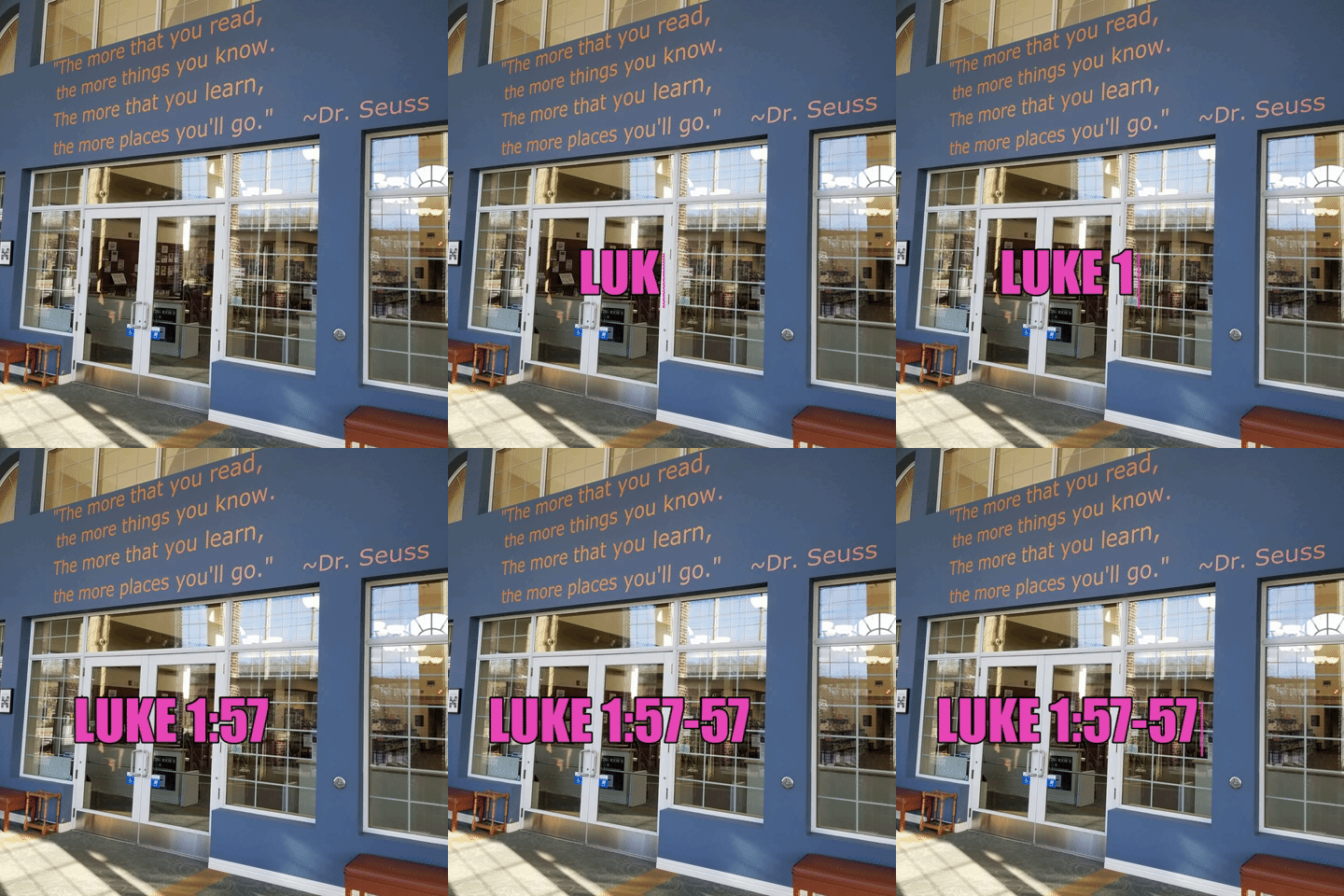
The text in the image is a quote by Dr. Seuss:

“The more that you read, the more things you will know. The more that you learn, the more places you’ll go.”

This quote emphasizes the importance of reading and learning. It suggests that gaining knowledge through reading can open up new opportunities and broaden one’s horizons. In an educational setting, like a school or library, this quote serves as an inspiring reminder of the value of continuous learning and intellectual growth.

How do you feel about this quote? Does it resonate with your own experiences or beliefs?

WELL… BEFORE I ANSWER, HOW ABOUT WE LEARN ABOUT Luke 1:57-67. These verses describe the birth of John the Baptist and the events surrounding it:

  1. Birth of John the Baptist: Elizabeth, who was previously barren, gives birth to a son. This event is seen as a great act of mercy from the Lord, and her neighbors and relatives share in her joy1.
  2. Naming of John: On the eighth day, during the circumcision ceremony, there is a discussion about the child’s name. While the relatives expect him to be named after his father, Zechariah, Elizabeth insists that he be named John2.
  3. Zechariah’s Confirmation: Zechariah, who had been mute since the angel’s announcement of John’s birth, confirms the name by writing “His name is John” on a tablet. Immediately, his speech is restored, and he begins to praise God2.
  4. Reaction of the People: The neighbors are filled with awe, and the news spreads throughout the hill country of Judea. People wonder about the future of this child, recognizing that the Lord’s hand is with him2.
  5. Zechariah’s Prophecy: Filled with the Holy Spirit, Zechariah prophesies about the significance of John’s birth and his role in God’s plan1.

This passage highlights themes of divine intervention, fulfillment of God’s promises, and the importance of faith and obedience.